We Are America
Gender Unavailable
By Ameera
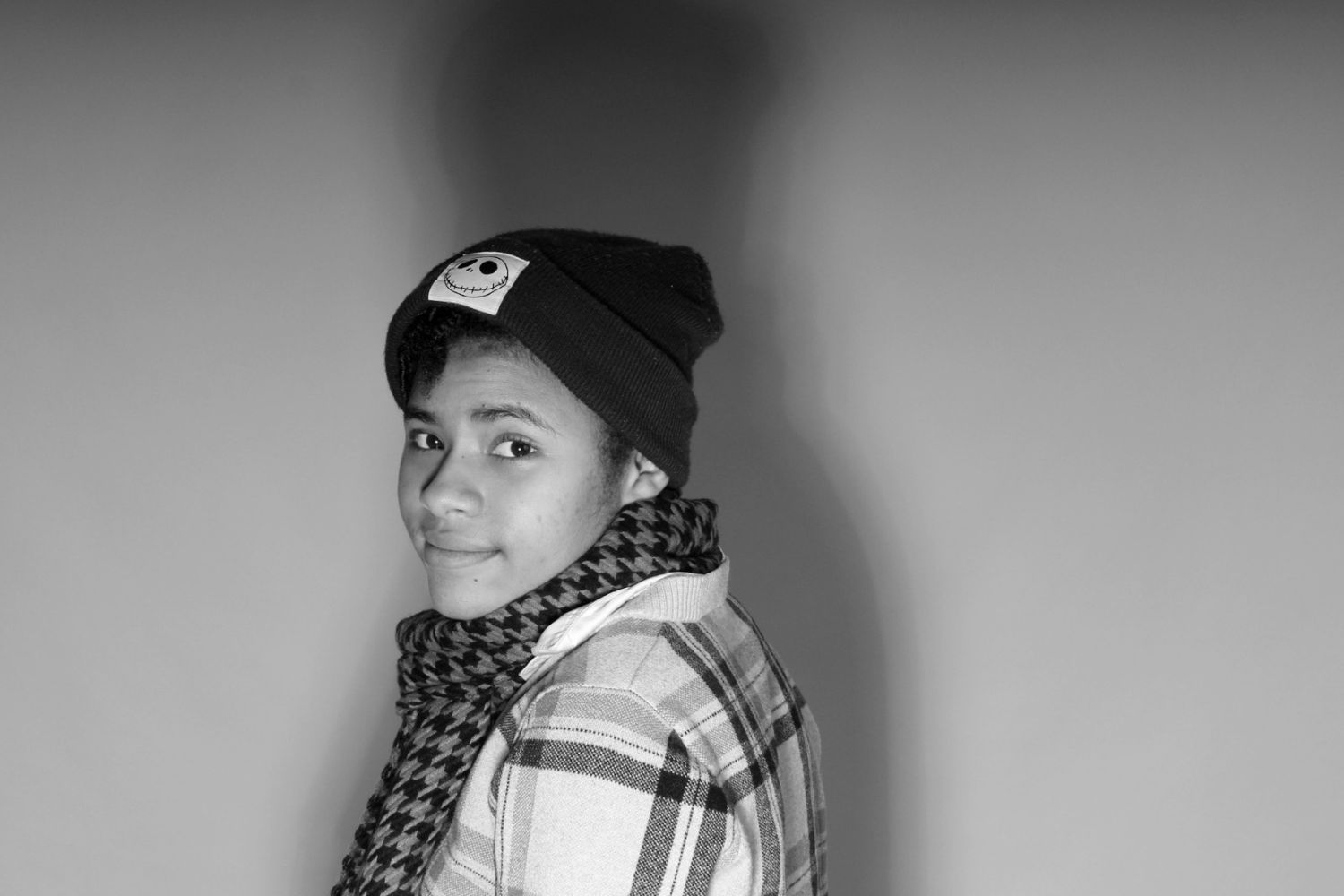
Appomattox Regional Governor's School for the Arts and Technology, Petersburg, Virginia
I’ve never fully identified with the label ‘girl’ or ‘woman.’ My face has too much facial hair—so much so that my little cousin noticed—and my nose is too wide. Even going through all the trouble to wash, blow-dry, and straighten my hair never fixed the way my face didn’t fit my image of ‘girl.’ I would never grow into a ‘woman’ worth pursuing with the face of a ‘man.’
I tossed around the idea of being transgender during the summer of my sophomore year. Unfortunately, my body was built differently from a male’s. My breasts were too big, my hips were too wide, and my overall muscle mass was lacking. Becoming a ‘man’ had just as many problems as comparing myself to a ‘woman’ did. Calling myself non-binary crossed my mind. I could wear frilly dresses or three-piece suits or none of that stuff at all; however, my insecurities with both genders overwhelmed me. My face didn’t fit the dresses, and my body was all wrong for the suits. Junior year, I let the turmoil rest for a bit as school and volleyball took up more of my processing power. I also joined a virtual gaming team to try something new. Since the gaming team only spoke online, we had only heard each other’s voices. Pronouns were something we were all thinking about, and my voice must’ve had them at a loss because I was asked twice.
The first time our captain asked me, I told her to use ‘he/they’ as my pronouns, even though I wasn’t sure that was what I wanted. I just didn’t want them to treat me like a ‘girl.’ My teammate asked me the second time, and I confidently gave him the same answer. In between those two moments, the captain mentioned something to me.
It was late—or early if that’s how you roll—around three in the morning, and it was the captain and me on call. We were chatting and paying minimal attention to the game.
“I think there’s only one black person on this team,” the captain said suddenly.
I knew who they were talking about, but I was surprised they sounded so confident.
I replied, “Really?”
“Yeah, he’s always saying the n-word.”
I contemplated giving away this fact about myself for a moment before saying, “I’m Black."
“Oh wow,” she paused, doing some movement on the other end of the call, “you don’t act black.”
I sat up and raised my eyebrow, although they couldn't see it. “Because I don’t go around yelling the n-word?”
“Yeah,” she said, sounding embarrassed. “I’m trying not to say that anymore.”
I poked a little fun at something they’d mentioned weeks ago. “You also didn’t know my gender.”
“You have a very genderfluid voice!” she exclaimed. And there was that word. I hadn’t even known that ‘girl,’ ‘boy,’ and ‘non-binary’ weren’t the only options. ‘Genderfluid’ had entered the game, and it had been bouncing around my head the next day. So, I looked it up, and it led me to the term ‘agender.’ Not identifying with any gender, just being as you are. And, while this term encompassed how I felt about my gender, I still had to pick pronouns. It was part of society now, and any pronouns wouldn’t do.
The second time around, using ‘he/they’ as my pronouns allowed my teammate to get a sense of the person I am. Most people assume ‘guys’ aren’t feminine, and adding ‘they’ in there should keep them from thinking I’m entirely masculine. Although ‘she/her’ is used by those who know me, it causes no more self-doubt. My mind and body have finally reconciled and now resonate pleasantly. I am, and no one can tell me otherwise, who I am.
I am free to be.
© Ameera. All rights reserved. If you are interested in quoting this story, contact the national team and we can put you in touch with the author’s teacher.